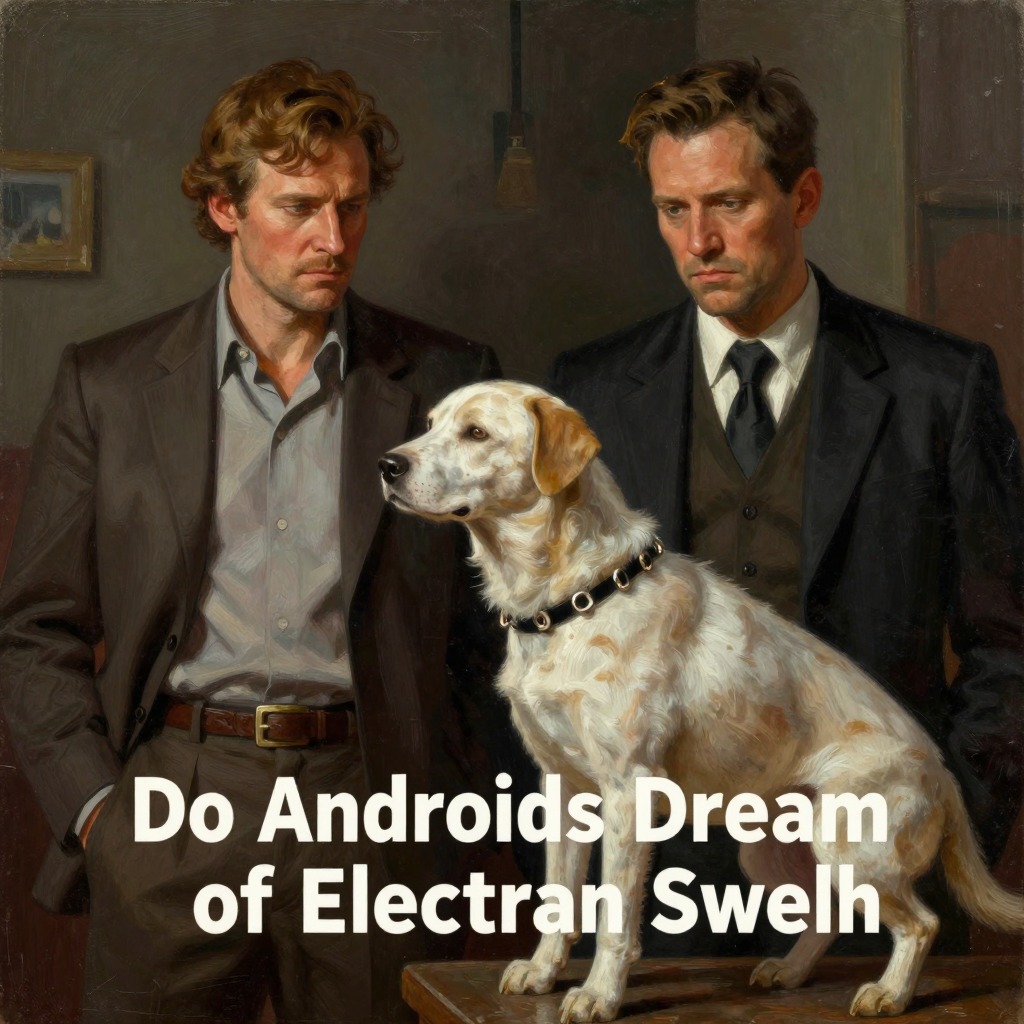
Retirement of Luba Luft
The Retirement of Luba Luft marks the emotional and ethical turning point of Rick Deckard's career as a bounty hunter. The event takes place at the San Francisco Museum of Art, where Luba Luft, a Nexus-6 android who had been performing as a soprano with the San Francisco Opera Company, has gone to view the Edvard Munch exhibition. Deckard and Phil Resch, a bounty hunter from the Mission Street Hall of Justice, track her there after she fled the War Memorial Opera House rehearsal. The killing, which occurs in an elevator, shatters Deckard's professional detachment and forces him to confront his own capacity for empathy toward androids.
The Hunt and the Museum Encounter
After the rehearsal ended and Luba Luft left the War Memorial Opera House, a stagehand told Deckard and Resch that she had gone to the museum to see the Munch exhibit, which was ending the next day. The two bounty hunters found her standing absorbed before a drawing of a young girl seated on the edge of a bed, an expression of bewildered wonder on her face. Deckard approached her and said, "Want me to buy it for you?" holding her upper arm with a loose grip that signaled his possession of her. Resch put his hand on her shoulder, and Deckard saw the bulge of his laser tube. Luba Luft recognized Deckard and said, "I thought they arrested you. Do you mean they let you go?" Deckard told her that the harness bull who arrested him was an android, as was his superior, Inspector Garland, and that Garland had said they all came to Earth in one ship as a group. Resch added that the police department operating out of the Mission Street building was the organizing agency by which her group kept in touch. Luba Luft then turned to Resch and said, "You're not human. No more than I am: you're an android, too." Resch replied, "Well, we'll deal with that at the proper time." They prodded her toward the museum elevator, one on each side.
The Elevator Execution
At the end of the corridor near the elevators, a small store sold prints and art books. Luba Luft halted there and asked Deckard to buy her a reproduction of the Munch picture she had been looking at, Puberty. Deckard bought her a book of Munch's collected work for twenty-five dollars, using his own money. Resch objected that his departmental budget could never be stretched, but Deckard paid and handed the book to Luba. She said, "It's very nice of you. There's something very strange and touching about humans. An android would never have done that," glancing icily at Resch. She continued to gaze at Resch with hostility and aversion, saying, "I really don't like androids. Ever since I got here from Mars my life has consisted of imitating the human, doing what she would do, acting as if I had the thoughts and impulses a human would have. Imitating, as far as I'm concerned, a superior life form." She then asked Resch, "Isn't that how it's been with you, Resch? Trying to be —" Resch could not take it and dug into his coat. Deckard grabbed at his hand, saying "The Boneli test," but Resch said, "It's admitted it's an android. We don't have to wait." Deckard struggled to pry the laser tube away, but Resch fired. Luba Luft, in a spasm of frantic hunted fear, twisted and spun away, dropping as she did so. The beam missed its mark but, as Resch lowered it, burrowed a narrow hole into her stomach. She began to scream, crouched against the wall of the elevator, screaming like the figure in the Munch painting. Deckard, with his own laser tube, killed her. Her body fell forward, face down, in a heap, and did not even tremble.
The Destruction of the Book and Deckard's Reaction
With his laser tube, Deckard systematically burned into blurred ash the book of pictures he had just bought Luba. He did the job thoroughly, saying nothing. Resch watched without understanding and said, "You could have kept the book yourself. That cost you —" Deckard interrupted, "Do you think androids have souls?" Resch gazed at him in even greater puzzlement. Deckard said, "I could afford the book. I've made three thousand dollars so far today, and I'm not even half through." When Resch pointed out that he had killed Garland and Luba, Deckard said, "You can't collect. Not from your own department and not from ours. When we get to your car I'll administer the Boneli test or the Voigt-Kampff to you and then we'll see." His hands shaking, he opened his briefcase and rummaged among the crumpled onionskin carbons, saying, "No, you're not here. So legally I can't claim you; to make anything I'll have to claim Luba Luft and Garland." Resch suggested that Garland might have been lying to split them apart, but Deckard said, "I'm getting out of this business." Resch asked what he would go into, and Deckard said, "Anything. Insurance underwriting, like Garland was supposed to be doing. Or I'll emigrate. Yes. I'll go to Mars." Resch argued that someone had to do the job, but Deckard said, "They can use androids. Much better if andys do it. I can't any more; I've had enough. She was a wonderful singer. The planet could have used her. This is insane."
The Aftermath and Deckard's Self-Test
After the killing, Deckard and Resch went to Resch's parked hovercar on the roof of the War Memorial Opera House. There, Deckard administered the Voigt-Kampff test to Resch, who passed as human. Then Deckard asked Resch to administer a single question to him. He attached the adhesive disk to his own cheek and arranged the beam of light into his eye. He said, "I'm going down by elevator with an android I've captured. And suddenly someone kills it, without warning." Resch reported no particular response, with the left needle hitting 2.8 and the right 3.3. Deckard then said, "A female android," and the needles jumped to 4.0 and 6.0 respectively. Deckard removed the disk and shut off the beam, saying, "That's an emphatically empathic response. About what a human subject shows for most questions. Except for the extreme ones, such as those dealing with human pelts used decoratively... the truly pathological ones." He realized, "I'm capable of feeling empathy for at least specific, certain androids. Not for all of them but — one or two." For Luba Luft, as an example. He wondered if any human had ever felt this way before about an android. Resch said, "You're in a spot, Deckard," and suggested it was sex, because she was physically attractive. Deckard asked, "What about — not sex — but love?" Resch replied, "Love is another name for sex." Deckard stared at him and thought, "You're a good bounty hunter. Your attitude proves it. But am I?" Suddenly, for the first time in his life, he had begun to wonder.